
1X2 vs. Double Chance: Market Comparison
 Available in US
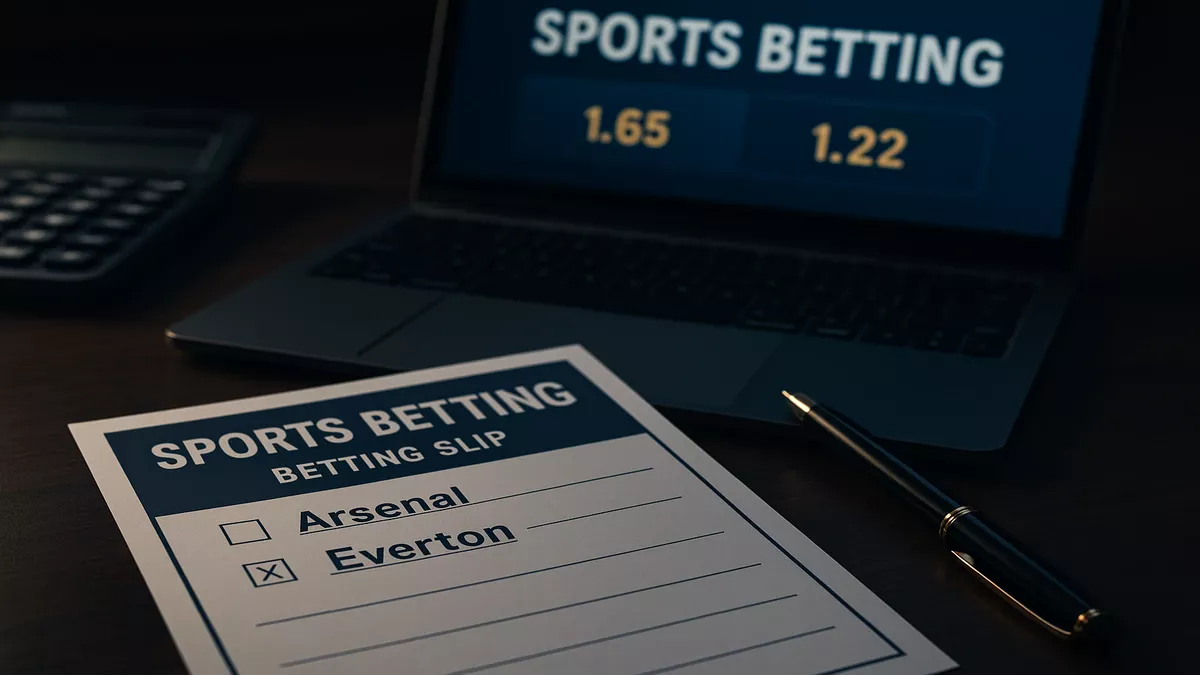
The betting slip sits in front of you. Arsenal playing Everton. You think Arsenal probably wins, but Everton’s defensive record suggests they might grind out a draw. Do you back Arsenal straight at 1.65, or play it safe with Arsenal or Draw at 1.22? One option offers better odds, the other better chances. Which actually makes you more money long-term?
This decision confronts bettors constantly, and most people get it wrong by focusing on the wrong variables. They pick based on feelings about risk tolerance rather than calculating which market offers better expected value for the specific match circumstances. The difference between 1X2 and Double Chance isn’t just about safety versus reward. It’s about understanding when each market structure provides genuine edges versus when it’s just psychological comfort costing you money.
Let’s break down exactly how these markets work, when each makes mathematical sense, and why the conventional wisdom about “safer bets” often leads straight to long-term losses.
Learn how to find better prices by understanding 1×2 handicap betting.
- Understanding the Core Differences
- When 1X2 Makes Mathematical Sense
- When Double Chance Actually Works
- Profitability Analysis Over Time
- Success Rate Realities
- Market Efficiency Considerations
- Building Optimal Strategy Combinations
- Psychological Factors and Discipline
- Case Studies and Real Examples
- Final Strategic Recommendations for 1X2 and Double Chance Betting
Understanding the Core Differences
1X2 betting forces you to pick one outcome from three possibilities. Home win, draw, or away win. You nail the exact result or you lose everything. The odds reflect this higher difficulty with better potential returns.
Double Chance lets you cover two outcomes simultaneously. You can bet home win or draw, away win or draw, or home win or away win. Two paths to victory, but significantly lower odds compensate for the increased probability of winning.
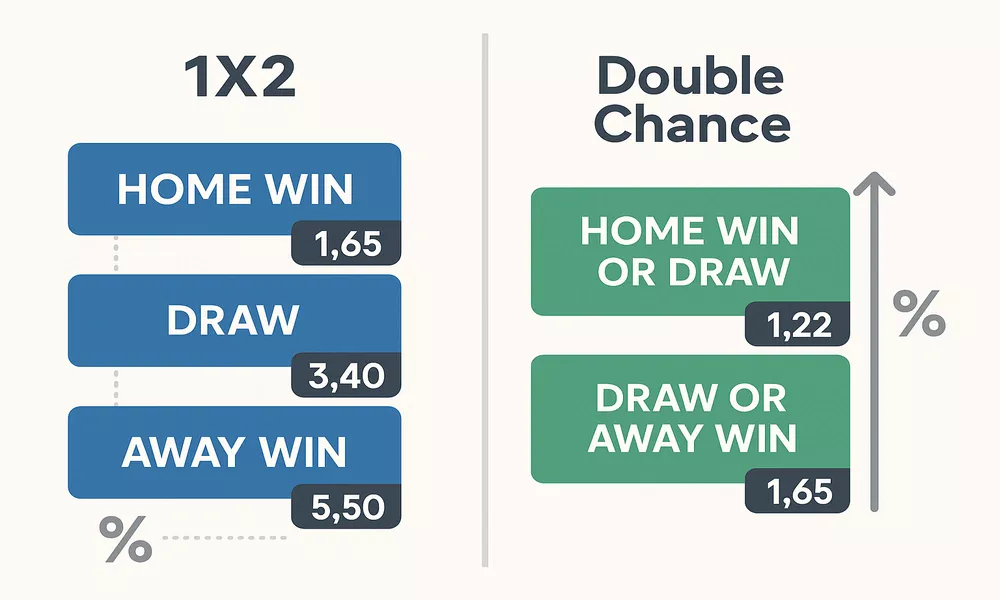
The mathematical relationship between these markets comes down to combining probabilities. Say Arsenal has 55% chance of winning and the draw sits at 25%. A Double Chance bet on Arsenal or Draw covers 80% of possible outcomes. The bookmaker prices this by roughly combining the odds from both individual outcomes then adjusting for their margin.
Arsenal to win: 1.65 odds (60.6% implied probability including margin) Draw: 3.40 odds (29.4% implied probability) Arsenal or Draw: 1.22 odds (82% implied probability)
Notice how the combined probability exceeds 100% due to bookmaker margins stacked across both included outcomes. That overround costs you more in Double Chance markets than straight 1X2 bets because you’re effectively paying the margin twice.
The key insight most bettors miss: Double Chance doesn’t reduce the bookmaker edge. It reduces variance while actually increasing the mathematical disadvantage you face. You win more often but profit less overall unless you’re specifically targeting situations where the market misprices the combined probability relative to the individual odds.
When 1X2 Makes Mathematical Sense
Backing 1X2 outcomes works best when you hold strong conviction about a specific result and the odds accurately reflect or underestimate the probability. You’re not betting on “probably” or “hopefully” scenarios. You’re betting on situations where your analysis identifies clear edges in one particular outcome.
Strong favorites at home against weak opposition present textbook 1X2 opportunities. Manchester City hosting a newly promoted side carries maybe 75-80% win probability. The 1X2 odds might be 1.30, the Double Chance 1.08. That 1.08 pays terribly even though it’s “safer” because you’re covering outcomes that barely happen anyway. The 22% margin for error doesn’t justify cutting your potential return by 20%.
Matches where you’ve identified value in the draw reward 1X2 betting enormously. Two defensive mid-table teams meet, both averaging under 1 goal per match. Your analysis suggests 35% draw probability, but bookmaker odds imply only 28%. That edge exists only in the draw market specifically. Combining it with either team win dilutes the value into a Double Chance bet with no edge at all.
Away underdogs with specific tactical advantages against vulnerable home sides offer 1X2 value regularly. The market underestimates their chances because public money loads on home teams. Say Brighton travels to a struggling Newcastle. The 2.80 away win odds might represent genuine value based on tactical matchup and form analysis. The X2 Double Chance at 1.50 includes a draw that’s fairly priced, destroying the edge you identified in the outright win.
Volatile matches between attacking teams rarely produce draws. Both sides score frequently, defenses leak goals, managers prioritize attack over defense. These matches end with winners 80-85% of the time. The 12 Double Chance (home or away win, no draw) offers terrible odds around 1.10-1.15 despite eliminating an unlikely outcome. You’re better off picking which attacking side wins and backing them straight in the 1X2 market at 2.00-2.50 odds.
The common thread: 1X2 betting rewards conviction and specific edge identification. You’re not hedging or playing safe. You’re targeting the exact outcome where value exists and claiming full odds for being right.
When Double Chance Actually Works
Double Chance serves specific strategic purposes despite its mathematical disadvantages. The situations where it makes sense involve reducing variance in tight matches or exploiting specific promotional opportunities.
Moderate favorites against respectable opposition in low-scoring matches present legitimate Double Chance cases. Liverpool visits Atletico Madrid. Liverpool slightly better, maybe 42% win probability, but Atletico’s defensive organization makes draws likely at 32% probability. Away wins sit at 26%. The Liverpool or Draw Double Chance at 1.50 covers 74% of outcomes. While you sacrifice edge backing Liverpool straight at 2.20, you dramatically reduce variance if you’re building accumulators or working through promotional requirements.
Backing underdogs to avoid defeat in matches they’re unlikely to win outright justifies Double Chance occasionally. Championship side hosts Premier League opposition in FA Cup. The underdog might lose 60% of the time, draw 25%, win outright 15%. Their straight win at 6.50 odds offers poor value based on quality gap. But X2 (draw or away win) at 1.75 covering that 40% chance of avoiding defeat might represent value if bookmakers overprice the favorite’s dominance.
Accumulator construction benefits from Double Chance when you need certainty on one leg to make the overall bet profitable. You’ve identified three excellent 1X2 value bets at odds around 2.50-3.00 each, plus you want exposure to a fourth match where you’re confident a strong favorite won’t lose but can’t pick between win and draw. Using Double Chance for that fourth leg at 1.20-1.30 completes your accumulator without adding the massive risk of calling an exact result where you lack conviction.
Promotional offers sometimes shift Double Chance into positive territory. “Money back as free bet if your team leads then draws” effectively gives you free downside protection. Combined with Double Chance coverage, these promotions occasionally create arbitrage opportunities or enhanced expected value situations. Calculate carefully whether the promotion genuinely improves your edge or just makes poor bets feel better.
End-of-season matches where both teams need points to avoid relegation or secure promotion create situations where draws become unlikely as both sides must attack. The 12 Double Chance (either team wins) prices around 1.10-1.15 but covers 85-90% of likely outcomes. While the odds are terrible, it’s one of few scenarios where Double Chance matches probability accurately.
The critical distinction: Double Chance works when variance reduction justifies sacrificing edge, or when specific circumstances make two outcomes dramatically more likely than the third. It doesn’t work as general risk management tool because the odds reduction costs more than the safety provides.
Profitability Analysis Over Time
The long-term profitability comparison between 1X2 and Double Chance reveals why recreational bettors prefer Double Chance while professionals stick with 1X2 despite the higher variance.
Let’s run a simulation over 100 bets using realistic scenarios. Assume you’re a decent handicapper hitting 52% of 1X2 selections at average odds of 2.50. Your record: 52 winners at 2.50, 48 losers.
Total staked: 100 units Total returned: (52 × 2.50) = 130 units Profit: 30 units (30% ROI)
Now take the same analytical ability but apply it to Double Chance betting. Because you’re covering two outcomes, your win rate jumps to 72% (your original 52% winners plus roughly 40% of the losses that would have hit your second covered outcome). But average odds drop to 1.38 to account for increased win probability.
Total staked: 100 units Total returned: (72 × 1.38) = 99.36 units Profit: -0.64 units (-0.64% ROI)
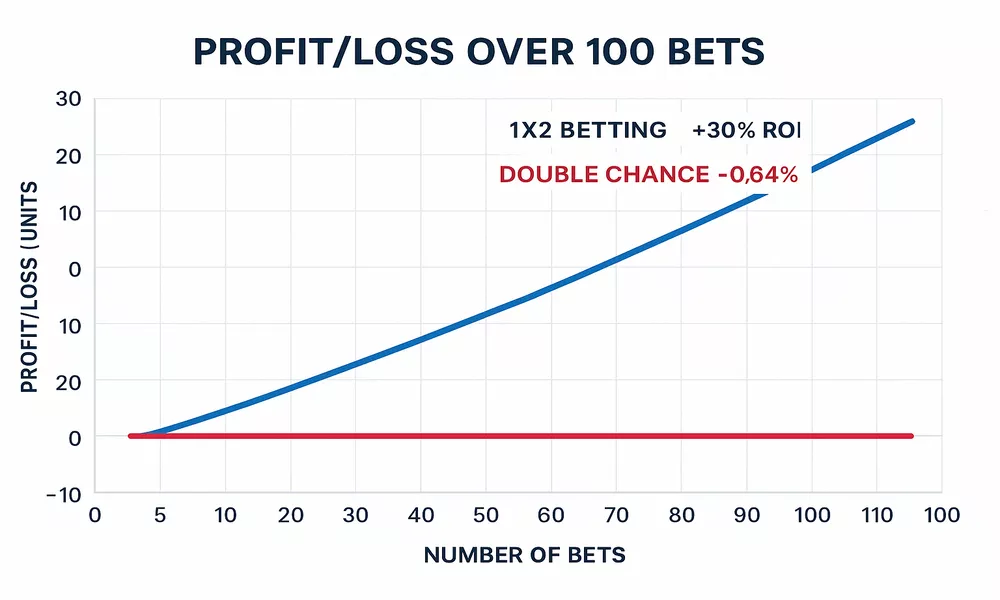
Same handicapping skill, different market structure, dramatically different results. The Double Chance approach turns profitable 1X2 betting into break-even or losing betting because the odds reduction exceeds the benefit of covering additional outcomes.
The math gets worse when you factor in bookmaker margins. Typical 1X2 markets carry 5-7% overround. Double Chance markets average 8-10% overround because the bookmaker margin compounds across both included outcomes. You’re fighting a bigger mathematical disadvantage before your handicapping edge even matters.
Consider favorite-heavy strategies where bettors chase high win rates. Backing favorites at 1.40 requires 72% accuracy to break even. Many bettors achieve 68-70% win rates, losing slowly while feeling successful because they win most bets. Switching those same favorites to Double Chance at 1.15 requires 87% accuracy to break even. Nobody hits 87% long-term. The “safer” approach absolutely guarantees losses.
The only scenario where Double Chance outperforms 1X2 financially involves being correct about combined probabilities while being wrong about individual outcomes. You consistently identify matches where two outcomes are more likely than the market prices, but you can’t distinguish which of those two outcomes will hit. That’s an unusual edge to possess and difficult to validate statistically.
Success Rate Realities
The psychological trap of Double Chance centers on win rate versus profitability. Humans naturally prefer winning more often even when it costs money long-term.
Professional 1X2 bettors typically hit 45-55% win rates depending on the odds range they target. Backing favorites around 2.00 odds might yield 52-54% accuracy. Backing longer shots at 3.00-4.00 odds drops to 48-50% accuracy. Both strategies profit because the odds compensate for lower win rates.
The emotional experience of 1X2 betting involves regular losses. You place ten bets, five or six lose. It feels unsuccessful even though your five winners at 2.50 odds return 12.5 units from 10 staked for 2.5 units profit. The logical brain knows you’re profitable, but the emotional brain fixates on losing more bets than you win.
Double Chance creates the illusion of success through higher win rates. Those same ten bets produce eight winners at 1.38 odds, only two losses. Feels much better. You’re winning 80% of bets! But those eight winners return only 11.04 units from 10 staked. You’re still losing money, just losing while feeling better about yourself.
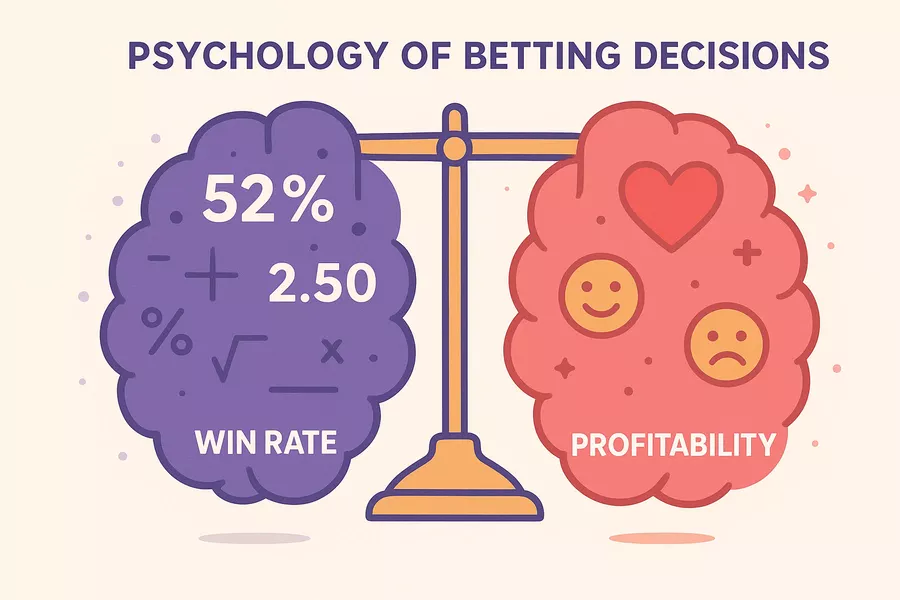
The data on betting psychology shows bettors consistently overweight win rate relative to profitability. Given a choice between:
A) Win 40% of bets, average odds 3.00, ROI of 20% B) Win 70% of bets, average odds 1.42, ROI of -1%
Most casual bettors choose option B. They’d literally rather lose money slowly while winning most bets than make money while losing more bets than they win. This psychological bias explains why bookmakers promote Double Chance markets aggressively despite them being terrible value for customers.
The success rate realities that matter for profitability have nothing to do with how often you win. They center entirely on expected value and whether your edge overcomes bookmaker margins. A 35% win rate at 4.00 average odds crushes a 75% win rate at 1.30 odds in every meaningful way except emotional comfort.
Market Efficiency Considerations
Different markets demonstrate different levels of efficiency based on betting volumes and sharp money involvement. Understanding these efficiency gradations helps identify where edge exists more readily.
Premier League 1X2 markets are brutally efficient. Billions in global betting volume flow through these matches. Sharp bettors and syndicates hammer inefficient prices immediately. The opening odds align closely with closing odds because the market corrects quickly. Finding consistent 1X2 value in Premier League requires superior models or information unavailable to the broader market.
Double Chance markets for the same matches demonstrate slightly less efficiency because recreational bettors dominate the action. Professional bettors rarely touch Double Chance because the margins are worse and the strategic utility limited. This creates small pockets of exploitable value when bookmakers misprice the combined probability relative to individual outcome odds.
Lower-tier leagues show reversed efficiency patterns. Romanian second division 1X2 markets lack the liquidity and sharp money flow that keeps major leagues efficient. Opening odds sometimes differ dramatically from true probability. But Double Chance markets for these obscure fixtures demonstrate even worse inefficiency because bookmakers put minimal effort into pricing markets that generate trivial betting volumes.
The practical implication: in heavily bet major leagues, both markets are efficient but Double Chance slightly less so. In lightly bet minor leagues, both markets are inefficient but 1X2 less so. The optimal strategy adjusts to these reality checks. Focus on 1X2 betting where you develop edges through superior analysis. Consider Double Chance only in specific situations where your edge involves combined probability assessments the market misprices.
Live betting changes the efficiency calculation entirely. In-play 1X2 odds shift violently based on score, possession, and momentum. These rapid swings create exploitable overreactions for bettors who remain calm and analytical. Double Chance odds move less dramatically in-play because covering two outcomes provides natural hedging against short-term volatility. The reduced movement means fewer opportunities for value betting.
Building Optimal Strategy Combinations
The binary choice between 1X2 and Double Chance presents false limitations. Sophisticated bettors use both markets strategically based on specific circumstances rather than pledging allegiance to one approach.
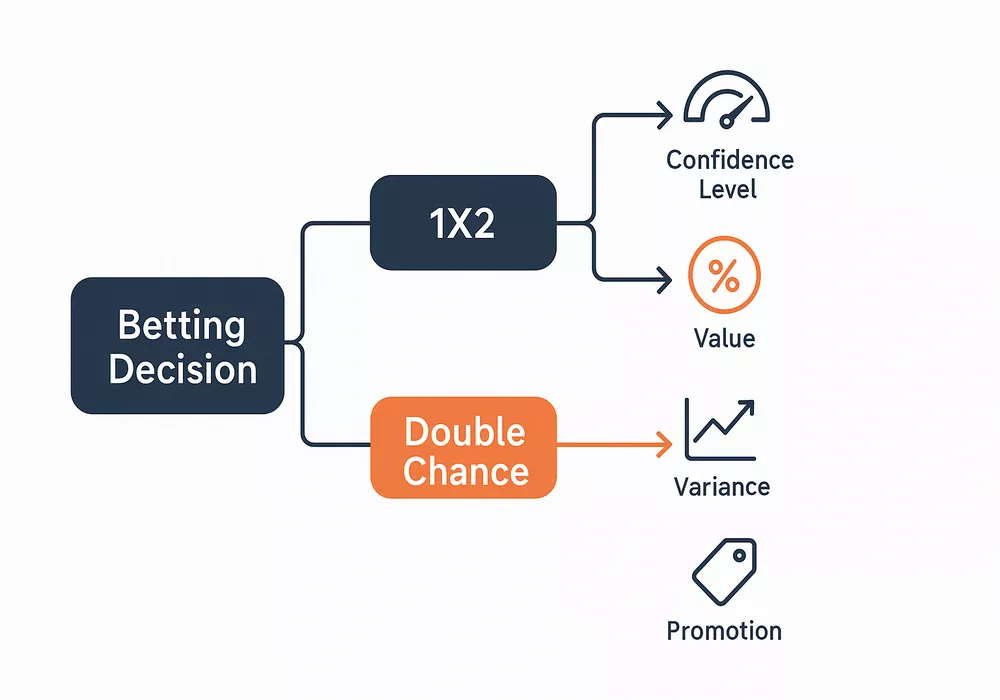
Develop a decision framework based on confidence levels and odds value. When you identify clear value of 5%+ in a specific 1X2 outcome, bet it straight. When you’re confident two outcomes are more likely than market pricing suggests but unsure which will hit, consider Double Chance if the combined odds still offer positive expected value.
Use 1X2 for the vast majority of bets because that’s where clean edges exist most frequently. Reserve Double Chance for specific situations: reducing variance in accumulators, exploiting promotional opportunities, backing underdogs to avoid defeat when outright wins seem unlikely, or rare cases where you’ve identified combined probability mispricing.
Track performance separately in both markets. After 200+ bets, you’ll see clearly whether your Double Chance results justify the approach or whether you’re sacrificing profits for psychological comfort. If your Double Chance ROI trails your 1X2 ROI significantly, you’re using it wrong and should stick with 1X2.
Consider staking adjustments between markets. Flat betting works well for 1X2 selections where each bet represents similar edge identification and conviction. Double Chance bets might warrant smaller stakes because you’re deliberately sacrificing edge for variance reduction. Why bet the same amount when you know one bet type offers worse value mathematically?
Build league-specific strategies recognizing that optimal market usage varies. Serie A’s high draw frequency makes Double Chance less attractive because that third outcome hits often enough to matter. Bundesliga’s low draw rate creates situations where 12 Double Chance (excluding draws) occasionally makes sense. Adjust your approach to league-specific statistical realities rather than applying blanket rules across all matches.
The goal isn’t choosing 1X2 or Double Chance as superior generally. The goal involves recognizing which market structure fits specific analytical edges and betting circumstances. Flexibility and contextual thinking beat rigid adherence to single approaches.
Psychological Factors and Discipline
The choice between 1X2 and Double Chance often reflects psychological comfort zones more than mathematical optimization. Understanding these biases helps you make better decisions.
Loss aversion drives bettors toward Double Chance betting disproportionately. The pain of losing a bet feels roughly twice as strong as the pleasure of winning an equivalent amount. Double Chance reduces loss frequency, making betting feel less painful emotionally even when it costs money mathematically. Recognize this bias in yourself and compensate by focusing on expected value calculations rather than win rate feelings.
Recency bias after losing streaks pushes bettors toward “safer” Double Chance options. You lose five straight 1X2 bets, suddenly every match looks risky. The instinct says play it safe with Double Chance to get a winner and restore confidence. That’s variance talking, not rational strategy adjustment. Losing streaks happen to everyone with winning strategies. Changing approach mid-variance guarantees you’ll never validate whether your original strategy works.
The sunk cost fallacy manifests when bettors convince themselves they need Double Chance to protect existing accumulator legs. You’ve nailed four legs at decent odds, now you’re considering adding a fifth using Double Chance at 1.25 “to protect the investment.” That’s backwards thinking. The four winning legs already happened. They’re not investment to protect. The fifth bet stands independently and should only be placed if it offers value. Low odds don’t somehow become worthwhile because previous bets won.
Overconfidence in favorites leads to Double Chance usage that costs money systematically. You love Manchester City to beat Bournemouth but the 1.20 straight win odds feel too low. So you combine City with draw at 1.08, convincing yourself it’s “basically guaranteed.” Nothing is guaranteed, and 1.08 odds are terrible value regardless. If you can’t find value in the straight win, don’t create fake value by combining outcomes.
The discipline required for optimal market usage involves sticking with 1X2 betting through inevitable variance while resisting the emotional pull of “safety” in Double Chance. You need psychological resilience to lose more bets than you win while trusting your process and expected value calculations. That’s harder than it sounds, which is why most bettors gravitate toward approaches that feel better while performing worse.
Case Studies and Real Examples
Let’s examine specific matches where the 1X2 versus Double Chance decision played out with clear winners and losers.
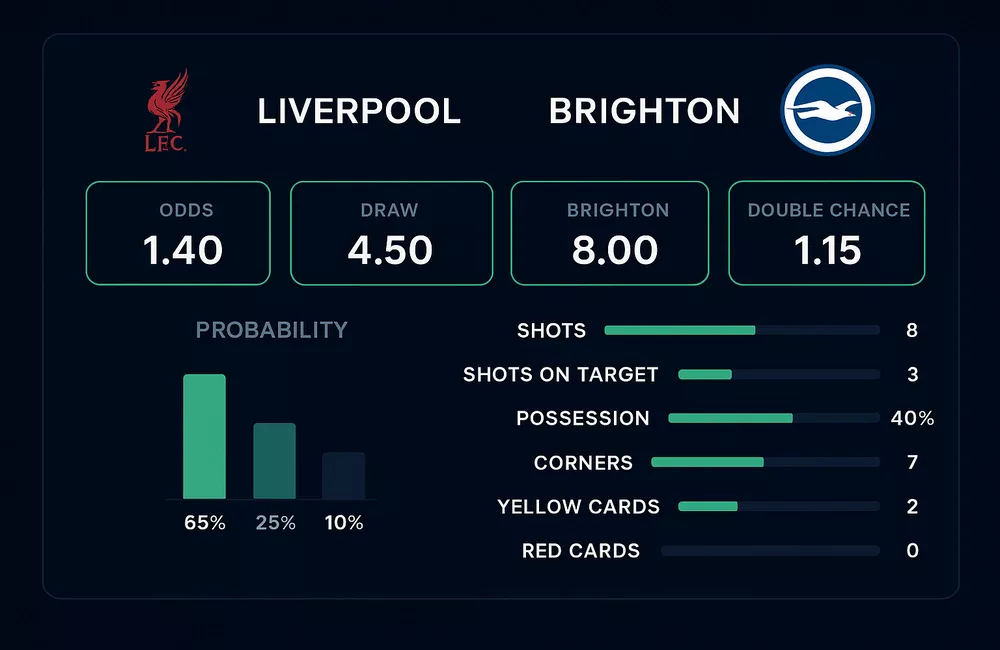
Liverpool hosting Brighton midseason. Liverpool strong favorites, Brighton defensive and organized. The odds: Liverpool 1.40, Draw 4.50, Brighton 8.00. The Liverpool or Draw Double Chance: 1.15.
The value-seeking bettor analyzes the matchup. Liverpool should win roughly 65% of the time based on underlying metrics. But Brighton’s defensive structure and Liverpool’s occasional struggle against deep blocks makes draws possible at 25% probability. Outright Brighton wins are unlikely at 10%.
Betting Liverpool straight at 1.40 requires 71.4% accuracy to break even. Your 65% assessment falls short, no value exists. Betting the draw at 4.50 represents slight value with 25% assessment versus 22.2% implied odds. The Liverpool or Draw Double Chance at 1.15 covers 90% of outcomes but requires 87% accuracy. No value anywhere except potentially the draw itself.
The optimal play: small bet on the draw at 4.50 or pass entirely. The amateur play: Liverpool or Draw Double Chance because it feels safe. The match ends 2-2. The draw bettor wins handsomely at 4.50 odds. The Double Chance bettor wins a tiny amount at 1.15. The 1X2 Liverpool bettor loses. The person who passed loses nothing.
Manchester United visiting Brentford, both teams mid-table and inconsistent. The odds: Brentford 2.70, Draw 3.30, United 2.60. The Brentford or Draw Double Chance: 1.50.
Analysis suggests Brentford’s home form gives them 40% win probability, draws happen 28% of the time, United wins 32% away. The 2.70 Brentford odds represent genuine value versus your 40% assessment. The Double Chance at 1.50 covers 68% of outcomes requiring 66.7% accuracy. You’re basically break-even on expected value with minimal upside.
The value-seeking bettor backs Brentford at 2.70. The risk-averse bettor takes the Double Chance at 1.50. The match ends Brentford 3-1. Both bettors win, but the 1X2 bettor captures full value from correct analysis while the Double Chance bettor makes significantly less despite being equally right.
These cases illustrate the core principle: Double Chance costs you money when you’re right because it dilutes edges by covering outcomes that either don’t offer value or actively reduce it. The “safety” is an illusion that makes you feel better while making you less money.
Final Strategic Recommendations for 1X2 and Double Chance Betting
After examining every angle of this comparison, clear guidelines emerge for when to use each market type and why.
Default to 1X2 betting for the overwhelming majority of your action. The superior odds and clean edge identification make it the foundation of profitable betting. Any time you can identify value in a specific outcome, bet it straight rather than diluting the edge through combination.
Use Double Chance only in these specific circumstances: reducing variance in carefully constructed accumulators, exploiting promotional offers that genuinely shift expected value positive, backing underdogs when you strongly believe they avoid defeat but can’t differentiate between draw and win, or rare situations where you’ve identified combined probability mispricing.
Never use Double Chance as emotional hedge against risk discomfort. If you can’t stomach losing individual 1X2 bets, you should reconsider whether betting suits your personality rather than choosing market structures that make losing money feel better.
Track your results religiously in both markets. Calculate win rate, average odds, and ROI separately. Let the data tell you whether your Double Chance usage serves strategic purposes or just costs you money. Most bettors discover they would be significantly more profitable eliminating Double Chance entirely.
Remember that bookmakers promote Double Chance heavily precisely because it’s worse value for customers. The “risk free” marketing appeals to loss-averse psychology while delivering inferior long-term results. When bookmakers emphasize certain bet types in their marketing, consider that a red flag rather than recommendation.
The path to betting profitability runs through making mathematically optimal decisions consistently rather than emotionally comfortable choices. 1X2 betting rewards conviction, analytical skill, and patience through variance. Double Chance rewards neither your analysis nor your bankroll in most circumstances. Choose accordingly.
Find the best value picks on our home page.
Expertly verified: Amelia Foster